The Allure of Handcrafted Mosaic Art in Dubai's Luxury Pools
In the world of luxury property design, few elements carry the weight of history and the sparkle of innovation quite like handcrafted mosaic art. For centuries, this meticulous craft has transformed surfaces into narratives, using tiny pieces of stone, glass, and ceramic to create images that endure. In Dubai, where the pursuit of the extraordinary drives architecture and interior design, swimming pools have become canvases for this ancient art form. The demand for bespoke aquatic installations that blend artistry with engineering is reshaping how we think about water features in high-end residences and hotels.
When you look at a swimming pool mosaic, you are seeing the culmination of techniques that trace back to ancient Mesopotamia and Greece. The Romans later refined the craft, but it was the Byzantine era that elevated mosaic to a spiritual art, with shimmering gold and vivid smalti decorating the walls of churches in Ravenna. Fast forward to the present, and that same reverence for detail is being applied to the turquoise waters of pools in the UAE. The shift from standard tile to handcrafted mosaic art represents a deeper appreciation for materials like Murano glass and Venetian glass, which offer a luminosity that machine-made tiles cannot replicate.
The Craft Behind the Surface
At its core, mosaic work is about the tesserae, the individual pieces that form the larger image. In handcrafted mosaic art, each tessera is considered for its color, texture, and light-reflecting properties. The process begins with selecting the right materials. For aquatic environments, glass is a favorite because it resists water damage and maintains its color under chlorine and sunlight. Murano glass, with its centuries-old production methods, produces tiles that have a depth and iridescence that change throughout the day. Venetian glass offers similar qualities, often with a slightly more translucent finish that works beautifully in shallow water.
Then there is smalti, the opaque glass enamel that has been a staple since the Italian Renaissance. Smalti is made by adding metallic oxides to molten glass, creating colors that are intense and consistent. When used in a swimming pool mosaic, smalti can create gradients and shadows that give a pattern a three-dimensional feel. The artist cuts each piece by hand, sometimes using a hammer and hardie, a traditional tool that leaves a slightly uneven edge. That irregularity is not a flaw, it is what catches the light differently and gives the surface life. A pool lined with these tiles becomes a living artwork, shifting with the angle of the sun.

From Byzantine Basilicas to Dubai Villas
The connection between ancient traditions and contemporary luxury is not a stretch. The same techniques used to create the floor mosaics in Ravenna and the ceilings in Florence are now employed to design custom installations for private villas on the Palm Jumeirah. The themes may have changed, but the discipline remains. Antoni Gaudí understood this when he used trencadís, a technique of broken ceramic and glass, to create the sinuous benches of Park Güell in Barcelona. Though his work is architectural, the spirit of treating a surface as a cohesive artwork is exactly what drives bespoke aquatic art today.
In the UAE, where climate and lifestyle center around outdoor living, the swimming pool is often the focal point of a garden or terrace. Owners are no longer satisfied with a simple blue rectangle. They want patterns that echo the geometry of Islamic art, or abstract compositions that mimic the movement of the sea. Some request gemstone mosaic accents, using semi-precious stones like lapis lazuli or mother of pearl to add a touch of opulence. These materials require specialized cutting and setting, a task that falls to artisans who understand both the aesthetic and the practical demands of a submerged environment.
Why Handcrafted Matters
The choice between mass-produced tile and handcrafted mosaic art comes down to character. A machine can cut a thousand identical squares in an hour, but it cannot replicate the subtle variations that make a handmade piece feel personal. In a luxury property, that individuality is part of the value. When you commission a custom installation, you are not just buying a pool finish, you are acquiring a piece that has been touched by human hands, each tessera placed with intention. This is especially important for aquatic art, where the interplay of water and tile requires careful planning. The refraction of water can distort a design, so the mosaicist must account for depth and viewing angles. An experienced artisan will adjust the color palette and tessera size to ensure the image reads clearly from the pool deck or from underwater.
There is also the question of longevity. Handcrafted mosaic art, when properly installed, can last for decades. The materials, particularly glass and smalti, are non-porous and resist staining. The substrate and adhesive must be chosen for wet conditions, but the tiles themselves are remarkably durable. This is one reason why historical mosaics survive after thousands of years. In a modern context, a well-made swimming pool mosaic becomes a legacy feature of the home, something that outlasts trends and continues to delight new owners.
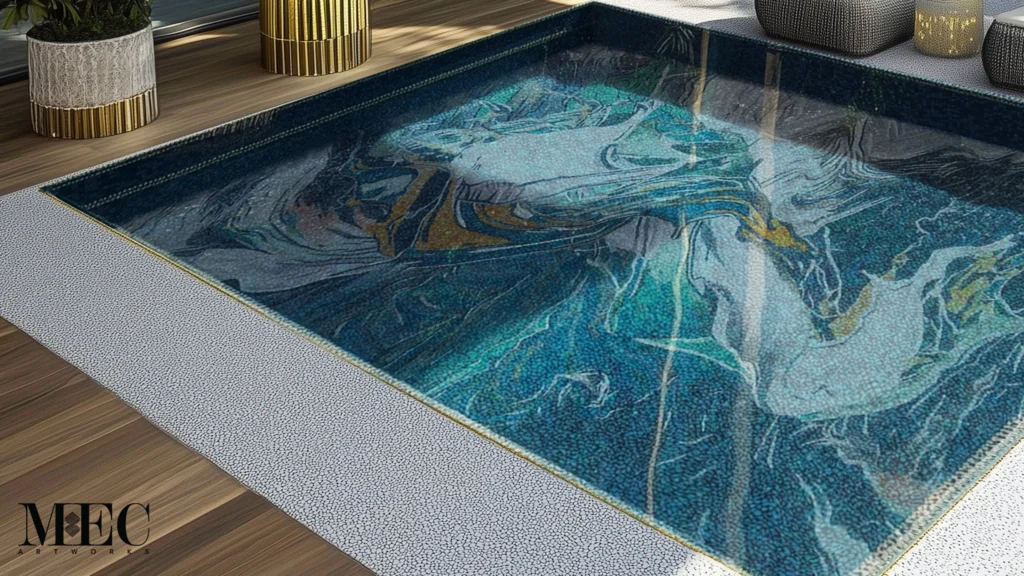
Key Considerations for a Custom Mosaic Pool
If you are considering a handcrafted mosaic for a pool, there are a few practical aspects to keep in mind. First, the design should be developed in close collaboration with the artist. A good mosaicist will want to see the space, understand the lighting conditions, and discuss the overall aesthetic of the property. Second, the installation process is slower than with standard tiles. Each section is laid out in sheets or individually placed, and the curing time for the adhesive must be respected. This is not a project that can be rushed. Third, consider the maintenance. While the mosaic itself is durable, the grout lines need care. Using an epoxy-based grout can prevent discoloration and reduce the need for frequent cleaning.
- Choose materials suited to water: Murano glass, Venetian glass, and smalti are excellent options for their color stability and resistance.
- Plan the design with the pool's shape and depth in mind, as water will magnify and shift the pattern.
- Work with an artist who has experience in aquatic installations, not just wall or floor mosaics.
- Allow for a longer installation timeline to accommodate the handcrafted process.
- Invest in quality grout and sealing to protect the mosaic from the chemicals and sun.
The Role of Light and Movement
One of the most captivating aspects of handcrafted mosaic art in a pool is how it interacts with water. As the surface ripples, the tiles seem to dance. Iridescent tiles, which have a metallic or pearlescent coating, catch the light and throw it back in shifting patterns. This effect is difficult to achieve with standard pool finishes. A custom installation can use a mix of matte and glossy tesserae to create contrast, or position the brightest colors near the waterline where they catch the most sun. Some designs incorporate a central medallion that becomes the visual anchor of the pool, surrounded by a field of smaller tesserae in complementary tones.
For those who want to push the boundaries, there are options like gemstone mosaic inserts. These use slices of agate or quartz set into the tile field, adding a level of luxury that is truly bespoke. The cost and complexity are higher, but the result is a pool that is genuinely unique. In Dubai, where the market for luxury property is competitive, such features can set a home apart. They also appeal to buyers who appreciate craftsmanship and are willing to invest in something that cannot be found in a catalog.
Looking Ahead
The future of handcrafted mosaic art in the UAE looks bright. As more homeowners and developers seek to differentiate their projects, the demand for skilled artisans will grow. The tradition of mosaic making is being kept alive by studios that combine old-world techniques with modern design sensibilities. Whether it is a pattern inspired by Islamic geometry, a freeform abstract image, or a faithful reproduction of a classical motif, the possibilities are vast. The key is to approach the project with respect for the craft and a clear vision of what you want the water to say.

In the end, a swimming pool is more than a place to swim. It is a space for relaxation, entertainment, and reflection. When that space is adorned with handcrafted mosaic art, it becomes a testament to the owner's taste and the artisan's skill. The next time you see a pool that seems to glow from within, look closely at the tiles. You may be seeing the work of hands that have been practicing this art for generations, now applied to the modern luxury of a Dubai villa. That continuity, from the floors of Ravenna to the pools of the UAE, is what makes this form of expression so enduring.